
Behind the Walls: Architect Alex Yuen interviews Edie Dillman, co-founder of B.Public Prefab for BeInkandescent Health & Wellness magazine

A Note from Hope Katz Gibbs, publisher, BeInkandescent Health & Wellness magazine — As we look forward to 2022, I can’t think of a better cover story of the January-February issue BeInkandescent magazine than architect Alex Yuen who will be interviewing Edie Dillman, CEO of B.Public Prefab.
“B.Public prefab panelized off-site construction system radically reduces carbon footprint while maximizing comfort and low-energy performance for new home construction,” explains Edie of her company based in Santa Fe, NM. “Craftsman prefab designed to exceed your greenest dreams.”
Alex and Edie discuss:
Why green design is essential to the future of architecture
How architects are responding to the challenge of economic and supply chain problems
The obstacles in making a change to current thinking about what green building means
And so much more!
Note: Alex and his partner Weijia Song, both professors at Harvard University Graduate School of Design, are collaborators in the Inkandescent Health & Wellness Retreat Center. We introduced them in the January 2021 issue of the magazine, and are excited to share more information this year about what we are cooking up.
Scroll down to learn more about Edie and Alex! And click here to read more about the Future of Building in the January-February 2022 issue of BeInkandescent magazine.
About Edie Dillman: The CEO and co-founder of B.Public Prefab has created a decidedly disruptive company, committed to systems change and the rapid adoption of solutions for the natural and the built environment. She is a proven leader of creative and business teams from architecture studios, web design firms to magazine publishing within a large variety of companies across non-profit, government, and the private sector.
In her previous work at Innovate + Educate, she worked nationally to shift to skills-based education and employment in the critical change for equitable workforce pathways. Before that, she was Publisher & Art Director of New Mexico Magazine, an enterprise venture within the New Mexico State Tourism Division. As the owner of her firm, Small Fires LLC, she worked with private clients for 15-years in strategic growth, product design, marketing, and communications.
Edie currently serves on the board of directors of the Santa Fe Art Institute, North American Passive House Network, and Talentnomics. These organizations support activists artists, building science transformation, and gender parity/diversity in business leadership. Learn more at bpulicprefab.com.
About Alex Yuen: Alex is an architect and urban designer hailing from Hong Kong and San Francisco. He is a founding partner of Collective Operations, a young practice dedicated to the improvement of the built environment through the combined capacities of design, research, and development with ongoing work in the US and New Zealand.
Alex received a Bachelor of Architecture from Rice University where his work was published, exhibited globally, and received numerous awards including the William Ward Watkin Fellowship and the Odebrecht Award for Sustainable Development.
He subsequently received a Master of Architecture in Urban Design (MAUD), with Distinction, from the Harvard Graduate School of Design where he received both the Award for Excellence in Urban Design and the Urban Design Thesis Award for his research and design proposal for a new platform for innovation in the American Rustbelt. Alex has previously brought his emphasis on multi-scalar design and representation to the faculty at the California College of the Arts and the University of Virginia.
Prior, he was an architectural and urban designer at the New York offices of Diller Scofidio + Renfro and the Office for Metropolitan Architecture (OMA) where he worked on a range of public, private, and research projects including the third phase of the Highline, and environmental resiliency plan for the city of Hoboken, and the competition winning proposal for the 11th Street Bridge Park. Alex is a registered architect in the State of New York.

BUILDING SANTA FE | A new build on Alto Street will be a test, but worth the wait

Santa Fe New Mexican, Sunday, Dember 25 2021
Upper Alto Street is the physical barrier to the barrio beyond. The high side has old historic homes set on traditional flat lots. The low side is a cliff two-stories deep. The homes there have grown up to street level, but some are only accessible by the last old-timey dirt road in the heart of the city, lower Alto Street.
The last vacant tract on the stretch, owned by the city, probably has been vacant since the upper barrio was settled some 200 years ago. The homes below, built after the river was tamed, are newer and fancier. The empty space will only hold five attached townhomes.
Now, to be tucked into the gap, will come five Habitat for Humanity homeowners, reminiscent of the hardworking, low-wage earners who originally established the barrio above. The city offered it free. The winning proposal came from Habitat and B.Public Prefab, a local women-owned high-performance panelized wall manufacturer headed by Edie Dillman, Charlotte Lagarde and Jonah Stanford.
It’s a perfect match and likely the only bidding team with the wherewithal to pull it off. Habitat builds cost effectively and with maximum energy efficiency under construction director Rob Lochner’s watchful, problem-solving eye.
But this is no ordinary build. Otherwise somebody would have built on it decades ago.
B.Public Prefab builds wall sections that are craned into place. Stanford and Dillman are stellar players in the realm of high-performance thought, design and construction in Santa Fe and beyond. Our local Habitat chapter already meets their high standards and is ready to embrace site challenges and new construction techniques.
One recent skillset mastered by Lochner and his core volunteers is working with concrete-filled insulating forms of Styrofoam blocks. They’re very energy efficient and can hold back tons of packed earth piled high behind a retaining wall. It’s hard to imagine a plan that would not employ such a scheme.
Those same concrete-filled foam blocks could serve as effective sound and fire barriers between the homes, which will have common walls. All five units will be two stories. Draft plans are for three three-bedroom homes and two two-bedroom homes.
Parking will be split between upper and lower Alto Street, but all five will have primary pedestrian access from lower Alto Street, which means all will have at least a little bit of private green space. The upper parking spots, made possible by the significant retaining wall and a lot of imported and compacted earth, will have stairs to bring pedestrians down from upper Alto Street.
B.Public Prefab’s walls, floors and roofs have sprung from Stanford’s pioneering work as a Passive House designer and builder. The sections use off-the-shelf products like I-joists, blown-in cellulose insulation, oriented strand board sheathing and water-resistant house-wrapping, but they are built to factory specifications and fit together like Legos.
It’s likely the Alto Street build will be a hybrid of B.Public Prefab panels and traditional techniques, like concrete slabs. Habitat’s lead architectural designer, Jacqueline “Jay” Urich, is a former AmeriCorps volunteer who discovered Santa Fe in her year of service with Habitat and made our town her home.
She is excited by the technical challenge and the challenge that modern townhomes must fit into historic vernacular required of new construction in historic districts.
Unlike other Habitat projects, where adjacent lots can be utilized for large groups of volunteers to meet and eat and assemble, this will be more surgical. With complicated site engineering and time-consuming historical approvals, Lochner is projecting a late-summer start but a quick build.
After a few hundred years, what’s a few more months? Take the time and get it right.
Kim Shanahan has been a Santa Fe green builder since 1986 and a sustainability consultant since 2019. Contact him at shanafe@aol.com.
City Selects Habitat for Humanity and B.PUBLIC Prefab to Develop Affordable Homes In Historic District


Press Release for City of Santa Fe
City Intends to Donate Lot at 635 Alto Street for Construction of Five High Quality, Low-Energy-Use Homes
November 29, 2021 – The City of Santa Fe Community Development Commission, chaired by Councilwoman Renee Villarreal, reviewed four responses to a Request for Qualifications (RFQ) seeking a developer to build five (5) affordable homes on a City-owned lot. The highest scoring application was submitted by Santa Fe Habitat for Humanity, in collaboration with B.PUBLIC Prefab.
The evaluation criteria for the RFQ called for demonstrated capacity in four areas: development program (unit mix and affordability); concept and design (satisfaction of desired design elements and zoning conformance); experience and financial ability; and demonstrated project financial feasibility.
Mayor Alan Webber says: “By dedicating this lot for affordable, high-quality, sustainable housing in a desirable area of downtown Santa Fe, the City is taking another step toward creating innovative and equitable housing solutions. When we talk about preserving the character of our neighborhoods in ways that are inclusive, this is the kind of development we have in mind. Thanks to all the respondents for their proposals, and congratulations to Santa Fe Habitat for Humanity and B.PUBLIC Prefab on their winning plan.”
Edie Dillman, CEO and Co-founder of Santa Fe-based B.PUBLIC Prefab, says: "Habitat Santa Fe has been building homes for better comfort and energy savings for many years. By building this development with our pre-insulated structural walls, the community can see the shell of this project complete in a matter of days. Then we all can cheer staff, volunteers, and partner families as they complete construction. Our craftsman-built prefab is designed for 100-plus years of comfort and 80-90% energy savings. Now that is housing stability for occupants!"
The application proposes five homes, made affordable through Habitat’s unique approach of using the future homeowner’s “sweat equity,” in addition to many volunteer laborers, donated materials, and self-financed 0% interest mortgages. Kurt Krahn, Executive Director of Santa Fe Habitat for Humanity, estimates that these homes will cost approximately $185,000 to construct, with monthly housing payments of $600-$800.
“We are thrilled to pilot this approach with B.PUBLIC,” says Krahn. “The thermal envelope goes up in days rather than months, which simplifies framing, sheathing, and insulation into a single sequence, greatly reducing construction time and construction waste and resulting in a home with much lower energy use.”
The lot is located in a downtown historic district and within easy walking and biking distance to the Plaza and the River and Rail Trails. Current zoning allows a multi-unit structure with at least five units on the lot. The final design and development plan requires approval by the Historic Design Review Board.
Recognizing that land cost and site control can provide barriers to housing development, particularly affordable housing on an infill lot, the City proposes to donate the lot; the Governing Body must approve the final donation agreement. In addition, City code allows qualifying projects to receive other applicable fee waivers and incentives to bring down the cost of building and providing affordable homes.
Contacts: Terry Lease, Asset Development Manager; tjlease@santafenm.gov
Alexandra Ladd, Director, Office of Affordable Housing; agladd@santafenm.gov
HOME: House Building — Praise for Passive House Design

What makes a house feel like home? When it is quiet and peaceful? Full of natural light during the day and good-and-dark at night for sound sleep? With favorite art on the walls and books unpacked on their shelves? Some might say when it smells like fresh baked cookies (or enchiladas). For New Mexicans, we can feel home in a double adobe; an unmistakable solid, quiet, grounded feeling of a craft-made home.
As one of the co-founders of B.PUBLIC Prefab based in Santa Fe, I spend my work life talking to people about building differently with deeply insulated walls to achieve Passive House-like performance for new home construction. Because Passive House is still relatively young in the U.S. (12 years as compared to Germany's 30), very few new home customers have ever experienced being in, let alone living in, a house built on such rigorous energy-efficiency principles.
The Passive House system is, admittedly, a rather technical and complicated design to understand. The main thing many people I talk to are interested in knowing is: How does it feel? Is a home that uses 80% less energy uncomfortable or seem like a sacrifice? I find myself using my hands, gesturing over Zoom and relying on metaphors to answer. For example, I will ask people if they remember the first time they experienced radiant floors in winter and how relaxing it was on their bodies. What a thing to have warm feet and relaxed shoulders!
Passive homes are kind of like that, but with the additional gift of being so well-insulated and comfortable, from head to feet, that you always feel warmed like that, except without the heat on.
It is lovely to meet with clients in New Mexico because I can use the experience of adobe as a comparison to a Passive House in that Passives are incredibly quiet, have deep-set windows and provide an utterly relaxing sense of home within 17-inch-thick walls. New Mexicans also understand right away that things made with craft, care and natural materials feel like home and also last like a home should—for generations.
Outside of New Mexico, it gets ta little tricky. For those folks in California, for example, I sometimes compare Passive House to having things in common with a Tesla: they’re both electric and super quiet. Passive homes are designed to be electric-only, for indoor health and energy conservation. They are 50% quieter, compared to code construction, due to well-insulated envelopes, paired with high-performance windows.
Clearing up some confusion for folks across the Southwest who confuse Passive House with Passive Solar, I use one of my favorite working metaphors: the stainless steel thermos. Passive homes are made to be inactive like an insulated thermos. Passive, in the sense that the interior stays hot by holding in the heat effortlessly, by design, rather than needing energy added to it to keep warm.
I understand why there may be confusion. It is difficult to truly share all of the amenities and attributes of the Passive system of construction on the page or computer screen. You must step inside a Passive Home to sense the fullness of its warmth and serenity. It's a surround-sound of comfort.
More and more builders are proudly joining New Mexico’s long history of green building with some new ways to save the planet. In the process, they are still honoring what home should feel like for everyone.
Treehugger: B.Public Designs Panelized Passive House Prefabs Building systems that prioritize sustainability and a reduced carbon footprint.
A hundred years ago, if you wanted a house, you could order it from Sears. They had good basic designs with everything people wanted in an affordable package.

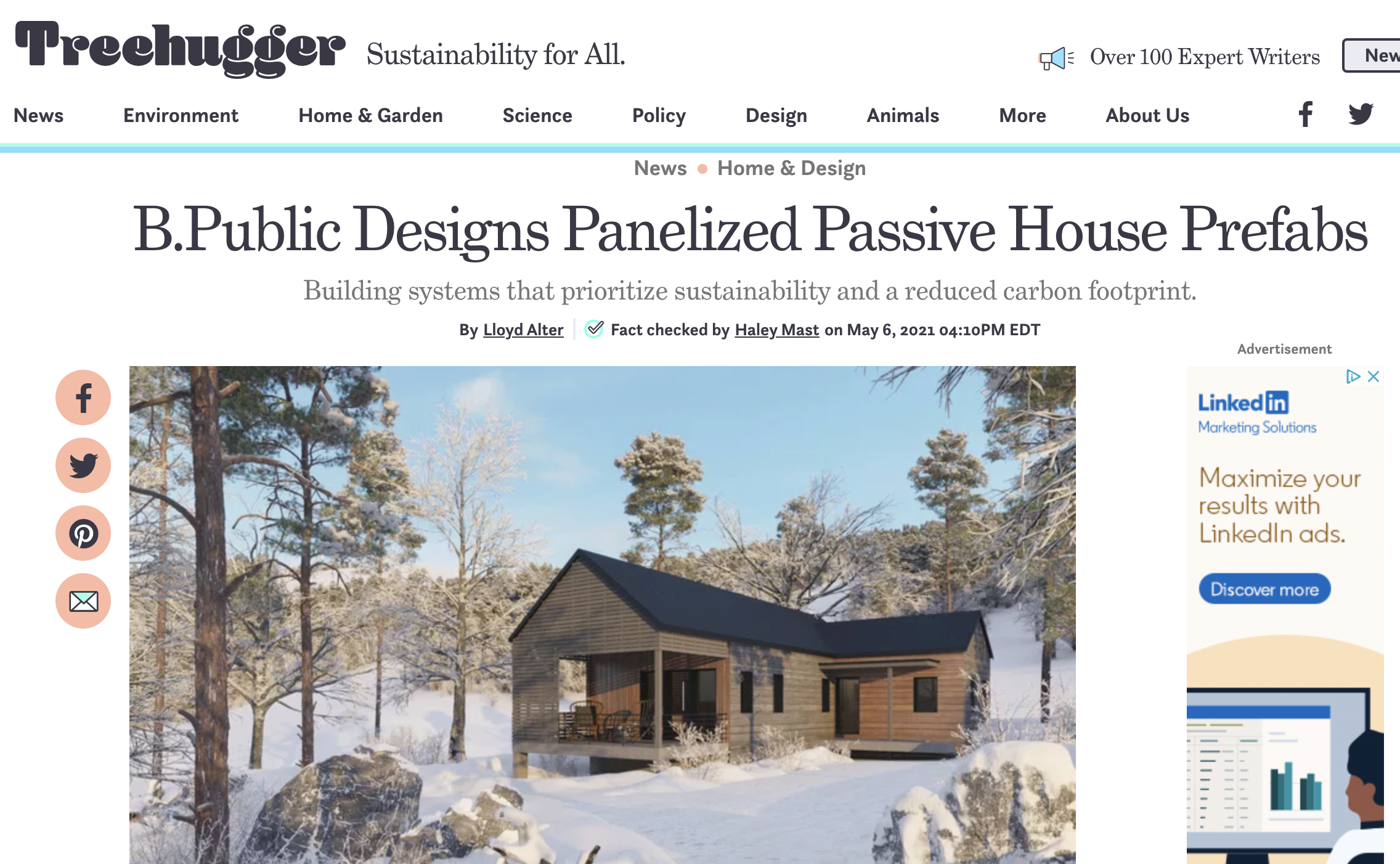
By Lloyd Alter Published May 6, 2021 Fact checked by Haley Mast
A hundred years ago, if you wanted a house, you could order it from Sears. They had good basic designs with everything people wanted in an affordable package. Colin Davies, author and professor of Architectural Theory at London Metropolitan University, wrote in "The Prefabricated Home": "Sears Roebuck never claimed to make any contribution to the progress of modern architecture. Its houses were indistinguishable from their ordinary site-built neighbors and its pattern books included all the popular, traditional styles."
Edie Dillman, CEO of B.Public Prefab, is trying to do exactly that. Her company supplies thick super-insulated wall panels that can be assembled into houses and low-rise multifamily buildings, but she also offers stock plans that architects, builders, and the public can use as starting points.
She explains to Treehugger why she does this: "I grew up in Chicago, surrounded by Sears homes. We just need good housing, We need houses that are well designed that people can live in. So why do we reinvent the wheel in design as well as how we assemble it?
Not everyone needs or can afford an architect, which is why Treehugger has shown many examples of stock plans and prefab packages. As Dillman notes, people say "I can't spend $50,000 and eight months for a two-bedroom house."
The plans are a great starting point for discussion and can be modified as required. Unlike Sears, B.Public doesn't include everything and the kitchen sink—just the enclosure, the panel system. The client then has a local contractor do the approvals, site work, and interior finishing; the plans get your attention and speed up the process.
The panels themselves are seriously high performance, with insulation values for walls of R-35 through R-52. They are wood-frame with dense-pack cellulose insulation, smart vapor control, and exterior sheathing. "The panelized building blocks of Floor, Wall, and Top (roof) components work together to create an envelope ready to be finished with interior and exterior finishes and cladding." Add the right windows and ventilation equipment and they would easily pass the Passive House standards.
They are all made from materials with low embodied carbon, addressing the crisis of climate change:
"We believe that architects, developers, builders have a professional mandate and responsibility to the earth and our environment. Status quo building practices must be replaced immediately with practical solutions that reduce the carbon footprint. To address increasing environmental shifts and disasters, the housing we create must be resilient, scalable, rapidly developed and support an evolving landscape."
They really do look like building blocks or as they describe them, "lego-like components" that "work together to create an envelope that is ready to be finished with interior and exterior cladding and surfaces, allowing for aesthetic and regionally appropriate treatments, finishes, and roof customization." This image shows them assembled into tiny cottages up to apartment buildings.
Architects like the panel system, but Dillman says "we're also attracting consumers with simple forms and likable shapes, designs that we understand as "homes," very recognizable for our human souls." Having these plans as a place to start also speeds up the design process.
As Davies concluded in his book, "The Prefabricated Home":
"Prefabrication does not necessarily imply either mass production or standardization. In fact, non of the three therms necessarily implies the other two. Standardization is not essential and mind-numbing monotony is not inevitable. On the other hand, standardization is not necessarily a bad thing; people like standard products that are tried and tested and available from stock. .... Offering customers a choice is one thing; asking them to design the whole building from scratch is quite another."
This is why what Dillman and her partners—Charlotte Lagarde and Jonah Stanford—have done is so clever: B.Public isn't selling a product that is really all that different than what a number of panel fabricators do. They don't even build the panels themselves but subcontract them. They have instead built a set of design tools and catalog of pieces that can be put together into a design quickly on a computer and then quickly on a site with everything fitting together nicely.
They have developed a foundation and other details that builders and architects can use, described in Passivehouse Accelerator as "a soup-to-nut service that included education, along with our offering of specific pre-manufactured building components and designs. Because, as they say on the website: "To design rapidly and know that performance will not be sacrificed is liberating."
B.Public is truly a 21st-century company: it is not a builder, it is not an architect, it is not even a panel manufacturer. It is all about an idea that removes a layer of complexity in dealing with panelized prefabrication, and about an ideal.
As Dillman explains: "B.PUBLIC is a woman-owned Public Benefit Corporation based in Santa Fe, NM. Our public benefit purposes are Housing Sustainability & Environmental Responsibility: Providing communities with building systems that prioritize sustainability, reduced carbon footprint, and resilience for equitable development." And that is a very good idea indeed.
. . .
Green Fire Times: B.Public Disrupting the Home Building Industry
We are trying to make this technology accessible so that it can be much more widely adopted,” Dillman said. “For low-rise construction with square corners and 10-foot ceilings,

“We are trying to make this technology accessible so that it can be much more widely adopted,” Dillman said. “For low-rise construction with square corners and 10-foot ceilings, we have created building blocks that will allow anyone to achieve high performance, comfort, sustainability and cost predictability. ”
With help from the Santa Fe Business Incubator, B.Public Prefab was recently launched to address the housing shortage and global climate crisis with a disruptive solution. The public-benefit (B) company offers high-performance, environmentally friendly modular building products and services. It was formed by partners CEO Edie Dillman, COO Charlotte Lagarde and Chief Technology Officer Jonah Stanford, who has been designing homes to Passive House standards since 2008. “Passive House” is a German standard for energy-efficiency that has been around for 30 years. B.Public’s prefabricated wall roof and floor panels speed construction, ensure quality craftsmanship and reduce a building’s energy consumption by up to 90 percent over its lifetime, while utilizing recycled and petroleum-free materials. The panelized components work together to create a super-insulating envelope. “Smart” vapor layers on the outside and on the interior breathe. The company offers licensed home designs with a complete set of construction drawings for single or multi-family homes, studios, eco-cabins and townhomes for infill or off-grid. B.Public provides technical assistance to homeowners, architects, builders and developers. “We are trying to make this technology accessible so that it can be much more widely adopted,” Dillman said. “For low-rise construction with square corners and 10-foot ceilings, we have created building blocks that will allow anyone to achieve high performance, comfort, sustainability and cost predictability. The innovative homes only cost 5 to 8 percent more than conventional construction. “We have lowered the barrier for builders and developers to be able to reach standards that only custom houses could aspire to achieve until now,” Dillman said. “Builders are key to serving clients and we are dedicated to supporting our local trades.” In January, after an installation crew of three erected and weathered a home near Angel Fire, New Mexico, in about a week, the B.Public team hosted local builders to tour the project. A growing list of clients are placing orders for the pre-fab panels.
Passive House Accelerator - Annual Publication Feature article
IF EVER THERE WERE A TIME TO ADDRESS THE HOUSING SHORTAGE, CLIMATE CRISIS, AND REDUCTION IN SKILLED LABOR WITH A COORDINATED, DISRUPTIVE SOLUTION, NOW IS THE TIME.
“IF EVER THERE WERE A TIME TO ADDRESS THE HOUSING SHORTAGE, CLIMATE CRISIS, AND REDUCTION IN SKILLED LABOR WITH A COORDINATED, DISRUPTIVE SOLUTION, NOW IS THE TIME.
That is the raison d’être behind B.Public, a recently launched, Santa Fe, New Mexico-based public-benefit corporation designed to change the status quo in building by offering prefabricated, high-performance, environmentally friendly building products and services. It was formed by Edie Dillman, Jonah Stanford, and Charlotte Lagarde, a trio of partners with complementary skills gleaned from a broad array of creative and innovative sectors."

Passive House Accelerator - Prefab Summit
Tune into the second Passive House PREFAB Summit for more off-site companies and a deeper dive into the nuts and bolts of building with prefab.
B.PUBLIC is pleased to be a part of a great series presented by the Passive House Accelerator.
Tune into the second Passive House PREFAB Summit for more off-site companies and a deeper dive into the nuts and bolts of building with prefab. What happens inside the factory? How do those panels get craned into place and attached on site? How does prefab affect the design workflow process? From large to small, each of six companies will describe its products and process. The event promises to be jam packed, covering everything from producing affordable housing to women’s opportunities in construction. Plus, there will be some surprise special guests.
Here’s the lineup for Summit II:
Ilka Cassidy from Holzraum System (and the link for single-family passive homes to Blueprint Robotics),
Paul Grahovac from Build SMART,
Tomaz Stich from Stich Consulting & Design,
Travis Toole from Build with Nature,
Alan Gibson from GO Logic, and
Edie Dillman from B.PUBLIC
David Arnott from TAG Panels
Graham Finch from RDH Building Science
Monday, December 14: 4–6pm Pacific/7–9pm Eastern.
Thank you to VaproShield and RDH Building Science, our joint Summit Sponsors.

"Angels Return" who would't love that headline?
Jonah Stanford and Edie Dillman of B.PUBLIC Prefab. The Santa Fe-based startup will seek a $100,000 investment at an upcoming investors roundtable, owner Dillman said.


New Mexico Angels resume looking for investment prospects
Jonah Stanford and Edie Dillman of B.PUBLIC Prefab. The Santa Fe-based startup will seek a $100,000 investment at an upcoming investors roundtable, owner Dillman said.
By Teya Vitu, Business Editor
A new energy has emerged for the New Mexico Angels, eager to once again invest in startup companies with high-growth potential.
The organization of more than 50 investors had been on hiatus since the start of the coronavirus pandemic as its president stepped down. But new President Drew Tulchin has an elaborate action plan for the group.
The Angels since 2008 have funded 62 companies, most in New Mexico, for more than $13.5 million, with that total stretching to $20 million since the organization’s inception in 1999.
Only four of those investments have been to Santa Fe companies: Meow Wolf, TheRetailPlanet.com, Verde and Vizzia Technologies. Tulchin, a Santa Fe resident, wants to see that change. He was the chief financial officer at Meow Wolf when it secured Angels funding.
Two Santa Fe companies will take part Nov. 20 in a virtual New Mexico Investors Roundtable put on by the New Mexico Angels and ABQid, which assists startup entrepreneurs. This will be the first roundtable in what Tulchin hopes will be a quarterly workshop session between investors and entrepreneurs.
“[Entrepreneurs] will present challenges, puzzles and barriers,” Tulchin said. “Angels will workshop a solution. Sometimes money isn’t the biggest thing.”
Santa Fe-based B.PUBLIC Prefab will seek a $100,000 investment at the roundtable, owner Edie Dillman said.
B.PUBLIC designs and supplies prefabricated building construction panels with sustainably harvested wood framing and insulation made of 86 percent recycled newspaper, Dillman said.
“We’re taking on strategic investors,” she said. “Our investors are [looking] for a better built environment.”
The company launched in January, and Dillman is seeking a first round of seed funding.
“We’re not interested in the traditional venture capital,” Dillman said. “It’s not about big returns for investors. But it’s still a good return.”
Santa Fe-based Parting Stone, which compresses cremated remains into rounded stones, was invited to take part in the New Mexico Angels workshop. Founder and CEO Justin Crowe seeks “resources and connections.”
“As a manufacturing company based in New Mexico, we are looking for people with experience in manufacturing,” Crowe said. “We are looking for a strategy to hire a large amount of staff quickly.”
Crowe launched Parting Stone in October 2019 in a garage with three people and now has 12 employees in a 3,000-square-foot facility. He predicts he will have more than 100 employees by 2024.
Crowe still considers Parting Stone a startup, with previous investor funding of $500,000 in August 2019 and $100,000 in October from the Arrowhead Innovation Fund in Las Cruces.
“We’re always looking for new partnership opportunities,” Crowe said.
Tulchin is an investor and adviser for both Parting Stone and B.PUBLIC as well as the former vice president of business development at Electric Playhouse and a similar position at Build With Robots, both in Albuquerque.
“Drew is the third president to take the reins since the NM Angels’ inception 20 years ago,” New Mexico Angels board Chairman Sherman McCorkle said in a news release. “He’s a seasoned, successful investor and entrepreneur.”
Predecessor John Chavez held the post for 12 years.
Angel investors are one option for cash-strapped entrepreneurs, who typically aren’t attractive for bank loans and rely on their own money or “the three F’s,” defined by Tulchin as “friends, families and fools.”
“Angels are called angels because they come in very early and help a startup to fly,” Tulchin said. “A loan is difficult for a startup to get. An angel is known for early money; a venture capitalist is more concerned about maximum return. An angel is more about building a relationship, an investor that wants to help startup companies. In New Mexico, we have more angels than VCs.”
Angels tend toward tech or manufacturing rather than restaurants and retail. This fits the definition Tulchin supplies of the sweet spot for angel investors.
“A startup with high-growth potential that can provide a return on investment,” Tulchin said. “Industry disruptors that are doing something new and different.”
Tulchin wants to bring more investors into the New Mexico Angels organization and fund many more startup companies.
“We want to see more happening,” he said. “We want to double or triple our volume, the number of business we help. We would like increased transparency from all the stakeholders and maximize collaborations. We also have to work with our banks. We need to be the experts to help everyone to do more capital raising for startup businesses. We want to build a big tent that everyone can shelter under.”
Tulchin is an advocate for working with other entities that support businesses, such as the New Mexico Finance Authority, Small Business Development Center and the state Economic Development Department. He wants to team up with venture capitalists, the Arrowhead Innovation Fund and nonbank lenders like DreamSpring and the small-business development and training organization WESST. “I often hear, ‘We didn’t know about that,’ ” Tulchin said. “We have a bunch of excellent organizations. We need entrepreneurs to understand the resources available to them. The right resources for the right need.”
Tulchin believes banks can be brought into the equation, even with much more stringent post-2008 lending restrictions that often leave startup entrepreneurs in the dark.
“We want to help entrepreneurs and bankers help each other,” Tulchin said. “Sometimes they are not used to each other’s language. We can help both achieve their goals.”
What does Tulchin look for in a startup company seeking investment?
“I would love to see an innovative idea, a team of people rather than one person, a team that would like to learn, that doesn’t think it has all the answers,” he said. “Another is a willingness to listen to customers.”
Santa Fe New Mexican | November 10, 2020
Teya Vitu,Business Editor
NAPHN Live - Free event featuring Jonah Stanford of B.PUBLIC
Your multifamily project design directives clearly prioritize environmental impact reduction, but at what cost? and what is the best indicator to measure? This presentation addresses pressing questions like.

Your multifamily project design directives clearly prioritize environmental impact reduction, but at what cost? and what is the best indicator to measure? This presentation addresses pressing questions like:
– What’s the construction cost-difference between site-built-code construction and prefabricated Passive House construction?
– How would the two approaches impact our project’s Carbon Footprint?
– What are the impacts of adding a lot of PV instead of pursuing Passive House?
– Why is there so little difference in HERS score between Code and Passive House construction?
– How would these decisions impact mortgages and utilities expenses?
Hosted By: Passive House Rocky Mountains, a Chapter of NAPHN
Presented by: Jonah Stanford, Principal, Needbased & CTO, B.Public Prefab
2 PM EST – 1 PM CT – Noon MT – 11 AM PT
1 AIA LU
Learning Objectives:
1. Layout reasonable comparisons of construction approaches for a community to understand the impacts of their decision to pursue prefabricated Passive House construction vs. typical site built code construction.
2. Reflect complicated carbon calculations into context for client understanding.
3. Describe the proportional carbon impacts of our design decisions when pursuing sustainable development.
4. Outline the impacts to a project’s total carbon footprint by measuring embodied carbon compared to carbon emissions.
5. Be able to convey a lot of complex data to a large group of people.
B.PUBLIC joins Friends of Architecture Santa Fe for PechaKucha
Join emcee, architect, and FASF President Anthony Guida, for a multi-faceted consideration of this contentious word—Profit. Our presenters—ranging from heritage developer to nectar nomad, drystone…
VOL. 7 PROFIT · Wednesday, July 22 @ 6 PM
Join emcee, architect, and FASF President Anthony Guida, for a multi-faceted consideration of this contentious word—Profit. Our presenters—ranging from heritage developer to nectar nomad, drystone mason, nonprofit architecture firm, manufacturer, urban planner, and creative director—share how they have invested and reaped the rewards. They will also challenge the current definition of profit and argue its significance, reframing the paradigm of wealth.
Edie Dillman of B.PUBLIC speaks to the theme of “Profit” without measuring the social, environmental impacts of how those profits were made is not the full picture. How do we flip that? How do we look at reduction—in wasted materials, harmful products, energy consumption, as the true measure of our success? This is where our power is—flipping our harmful and rigid business practices to carbon positive solutions that prove that profit and growth can be sustainable for generations to come. When buildings account for 39% of our carbon emission—11% in materials and 28% in the energy they consume—we must evolve the way we build for good, and we are.

The RDC’s Technology and Manufacturing Fund (TEAM) is a no-interest loan fund available to technology-based and manufacturing companies in the RDC's seven county service area.
B.Public Wins Team Fund Support

Images from left: A houseplan created by B. Public that prioritizes sustainability, reduced carbon footprint, and resilience for equitable development; Black Mesa Winery LLC; and Bicycle Technologies International (BTI).
Announcing RDC's 2020 TEAM Fund Recipients
The RDC’s Technology and Manufacturing Fund (TEAM) is a no-interest loan fund available to technology-based and manufacturing companies in the RDC's seven county service area. The fund supports growth-oriented companies who are on track to add jobs, grow revenues, and attract additional funding.
The recipients below represent a range of businesses innovating in their industries, including green building, super foods, vineyards and breweries, live streaming services, and more, all of which will help grow our economy. Look for more information about these growth companies in future newsletters.
The 2020 TEAM Fund Awardees are:
Apogee Spirulina, LLC - A spirulina algae company dedicated to cultivating the highest grade protein and nutrient-rich super food found on the American market. Funds will be used to purchase a weighing and filling machine and sealer equipment.
Bicycle Technologies International (BTI) – A distributor of bicycle parts, tools, and accessories. Funds will be used to buy a wheel lacing machine that will allow the company to add lower cost, higher volume wheels to their dealer catalog.
Black Mesa Winery, LLC - Velarde, NM, producer of hard ciders and wine beverages sourced from the local area's grape vineyards and apple orchards. Funds will be used to purchase equipment to increase the manufacturing production and distribution of the hard cider products.
Green Theme Technologies Inc (GTT) - Chemical and process technology for finishing textiles, including durable water-repellant treatment that uses no water or harmful chemicals and has no waste stream. Funds will be used to purchase equipment to scale-up and process debug.
Leaf & Hive, LLC - Micro-brewery and tasting room located in Santa Fe specializing in a honey-fermented, probiotic, alcoholic beverage. Funds will be used to purchase a mobile draft station/bar for festivals and other large events or gatherings, curating a unique drinking experience for customers.
OneforNeptune, LLC - Manufacturer of healthy, high-protein snack foods made from sustainable seafood products. Funds will be used to design, develop, manufacture and ship display cases to support retail expansion.
Phyteau, Inc. - Developer of a completely safe, new class of therapeutics for diabetes, weight-loss, obesity and related metabolic conditions. Funds will be used to assist with international patent-related costs and fees.
Public PBC/B.Public Performance Prefab – A disruptive company tackling the climate crisis and housing issues through innovative solutions and building science. Funds will be used for consultation and development of Building Information Modeling (BIM) library in Revit and AutoCAD.
Sixth Sense Designs, LLC - A product engineering & development house and manufacturing innovation center. Funds will be used to purchase a digital height gauge and convert a CNC router to a plasma cutter.
Xerb – Developer of a video streaming platform built for content creators. Funds will be used to purchase additional equipment needed to keep up with the demands of high growth.
Upcoming Online Event 5/7/2020
You may have seen B.PUBLIC CEO Edie Dillman educating and inspiring at Santa Fe Innovate’s recent Wanna Be a B-Corp? event. Well, we’re in for a treat, as B.PUBLIC is not only game…
KICK-ASS ENTREPRENEURS™ (KAE) Entrepreneur Story Time: B.PUBLIC (on Zoom)
REPOSTING FROM OUR FRIENDS AT KAE

Thursday, May 7, 2020 6:30 PM 7:30 PM Zoom Meeting (map)
You may have seen B.PUBLIC CEO Edie Dillman educating and inspiring at Santa Fe Innovate’s recent Wanna Be a B-Corp? event. Well, we’re in for a treat, as B.PUBLIC is not only game to share the story of why being a public benefit corp is so important to them, but Edie and her fabulous co-founder Jonah Stanford (who also happens to be her husband) will share with us more of the story behind the making of B.PUBLIC’s proprietary high-performance prefab building envelope that speeds construction and reduces energy consumption by up to 90% for the life of the building. Along with co-founder Charlotte Bervin-Lagarde, the team is gung-ho to introduce to Santa Fe and beyond a solution that incorporates materials that reduce environmental impact and deliver comfort like nothing else.
Edie said it best in a Facebook post: “I couldn't be more excited about 2020 and inspired to lead a decidedly disruptive venture. Here's to taking risks and making the world a better place. This is the right product, the right moment, with the right partners. We have the great fortune to bring to market solutions in prefab construction with drastically reduced carbon footprint, energy use, with craft-made quality. All while creating jobs, ensuring training, engaging in the community, and developing local networks. Grateful to serve a market that is hungry for fast - smart - beautiful building solutions. We might be a start-up but we are feeling the love and are incredibly fortunate that so many are cheering us on and supporting our growth. Here's to a killer decade ahead to make a dent in the housing need and reverse our carbon bingeing.”
Now I bet you’re as excited about B.PUBLIC as I am. Not only do they offer direct-to-consumer/developer options for those looking for a studio, home or multiple units that are beautiful, comfortable and have less impact on the environment (home plans that utilize their prefabricated system components), but they also partner with industry pros to provide prefabricated building envelope components direct to builders, architects and designers. They even offer training and introductions to design and building professionals on how to improve performance by utilizing the B.PUBLIC building envelope.
If you’re geeking out on B.PUBLIC like I am, head to their story/about us page, as it’s one of the best I’ve read in a while. And if you’re jonesing for more, the NMEDD hosted a webinar all about housing and B.PUBLIC chimes in @ minute 58 with some sweet slides and talk about solutions and tools for developing more housing for New Mexicans.
And we’ll gather to hear the story of what it’s like to build a public benefit corp based on building science on Zoom, baby. So grab yourself a drink and a bite, click the meeting link and settle in for Story Time. See ya there!
Zoom Meeting
https://zoom.us/j/98798123552?pwd=ZEtjU1hKRDBHQ3ZxNUNHYVJ6N0hYZz09
(Link above should be enough, but below in case you need 'em.)
Meeting ID: 987 9812 3552 Password: 505575
Santa Fe Innovates Incubator Launch Event
It was great fun to participate in the conversation at Santa Fe Innovates' launch event alongside Meow Wolf and Positive Energy to discuss the B-Corp movement and our choice to be a public benefit corporation with a triple-bottom-line.
It was great fun to participate in the conversation at Santa Fe Innovates' launch event alongside Meow Wolf and Positive Energy to discuss the B-Corp movement and our choice to be a public benefit corporation with a triple-bottom-line. If you are interested in their socially-responsible startup accelerator program don't miss their great work and the first cohort for a great new program partnering with UNM, Santa Fe Business Incubator. https://zcu.io/l4O3

When Passive is Powerful
Lovely feature article about co-founder Jonah Stanford and the beginning of B.PUBLIC in TREND magazine.
Lovely feature article about co-founder Jonah Stanford and the beginning of B.PUBLIC in TREND magazine.
Starts on page 88.
